
IT Great Falls - The Top 7 Benefits of Managed IT Services for Montana Businesses
Montana businesses face unique IT challenges that set them apart from their urban counterparts. Geographic isolation, limited access to specialized IT talent, connectivity constraints, and the need to
The Top 7 Benefits of Managed IT Services for Montana Businesses
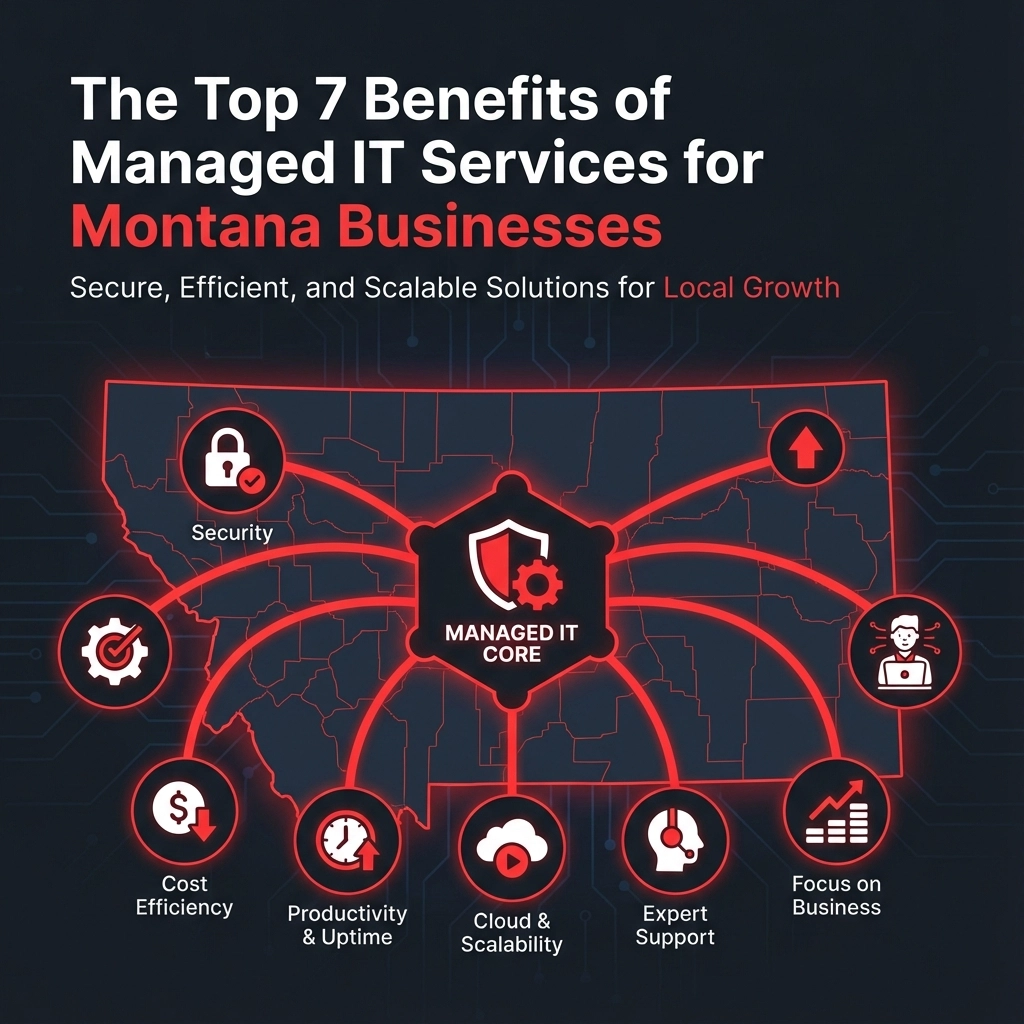
Montana businesses face unique IT challenges that set them apart from their urban counterparts. Geographic isolation, limited access to specialized IT talent, connectivity constraints, and the need to maintain robust security across distributed operations create a complex technology landscape. Whether you're managing a ranch operation in Miles City, running a manufacturing facility in Great Falls, or operating a professional services firm in Billings, these challenges demand innovative solutions that traditional in-house IT approaches often can't provide.
Managed IT services offer a strategic response to these Montana-specific obstacles, delivering enterprise-level technology capabilities regardless of your location or company size. By partnering with a managed service provider, Montana businesses gain access to comprehensive IT infrastructure management, advanced security protocols, and round-the-clock technical support that would otherwise require significant capital investment and ongoing operational expenses.
1. Significant Cost Reduction and Predictable IT Budgeting
The financial benefits of managed IT services become immediately apparent when you consider the true cost of maintaining an internal IT department. For most Montana businesses, hiring even one experienced IT professional represents a substantial investment: often $70,000 to $100,000 annually when factoring in salary, benefits, training, and equipment costs.
Managed IT services transform these unpredictable capital expenditures into manageable monthly operating costs. Instead of budget-breaking emergency repairs or costly system upgrades, you receive comprehensive IT management for a fixed monthly fee. This predictable pricing model enables better cash flow management and allows you to allocate resources more strategically across your business operations.
The cost advantages extend beyond personnel savings. Managed service providers leverage economies of scale to negotiate better pricing on software licenses, hardware procurement, and vendor partnerships. These savings get passed along to clients, often resulting in 30-40% lower total IT costs compared to maintaining equivalent capabilities internally.

2. Access to Specialized IT Expertise and Talent
Montana's limited IT talent pool creates significant challenges for businesses seeking specialized technical expertise. Finding professionals with current certifications in cybersecurity, cloud architecture, or enterprise network management often means competing with larger markets or accepting extended vacancy periods that leave critical systems vulnerable.
Managed IT services eliminate this talent constraint by providing immediate access to teams of certified professionals across multiple technology domains. Your business gains the expertise of security specialists, network engineers, cloud architects, and help desk technicians without the complexity of recruitment, retention, or ongoing training investments.
This expertise advantage becomes particularly valuable as technology continues evolving at an accelerated pace. Managed service providers invest continuously in staff training and certification programs, ensuring your business benefits from the latest technological advances and best practices. When new security threats emerge or innovative productivity tools become available, you have immediate access to professionals who understand implementation and optimization strategies.
The local expertise component cannot be overstated for Montana businesses. Providers like IT Great Falls combine deep technical knowledge with understanding of regional business challenges, regulatory requirements, and infrastructure limitations that affect technology decisions.
3. 24/7 Proactive Monitoring and Immediate Response
Traditional reactive IT support waits for problems to occur before taking action. This approach proves particularly problematic for Montana businesses where geographic distance can extend response times and system downtime directly impacts productivity and revenue generation.
Managed IT services implement continuous proactive monitoring that identifies potential issues before they escalate into business-disrupting problems. Advanced monitoring tools track server performance, network traffic patterns, security indicators, and application health metrics around the clock. When anomalies are detected, automated systems can often resolve minor issues immediately, while more complex problems trigger immediate technician intervention.
This proactive approach typically reduces system downtime by 60-80% compared to reactive support models. For a Montana manufacturing operation or agricultural business where equipment monitoring and data collection are critical, this reliability translates directly into operational efficiency and cost savings.
The 24/7 monitoring advantage extends beyond business hours protection. Montana businesses often operate across multiple time zones or maintain operations during non-standard hours. Having continuous IT oversight ensures that systems remain secure and functional regardless of when your team needs access to critical applications and data.

4. Advanced Cybersecurity Protection and Threat Management
Cybersecurity threats pose escalating risks for Montana businesses, particularly those in agriculture, energy, healthcare, and financial services sectors. Rural and small-town businesses often assume they're less likely targets, but cybercriminals increasingly focus on organizations with limited security resources and potentially valuable data.
Managed IT services deliver enterprise-level security capabilities that would be prohibitively expensive for most businesses to implement independently. This includes advanced threat detection systems, network perimeter security, endpoint protection, email filtering, and regular security assessments that identify vulnerabilities before they can be exploited.
The human element of cybersecurity proves equally important. Managed service providers maintain dedicated security specialists who stay current on emerging threats, attack vectors, and defensive strategies. These professionals design security protocols tailored to your specific industry requirements and risk profile, while providing ongoing employee training to prevent social engineering and phishing attacks.
For Montana businesses handling sensitive information: whether medical records, financial data, or agricultural research: comprehensive security protection becomes a competitive advantage as well as a operational necessity. Customers increasingly evaluate vendors based on their data protection capabilities, making robust cybersecurity a business development asset.
Our previous analysis of AI-enhanced cybersecurity approaches demonstrates how modern security tools can provide sophisticated protection even for smaller organizations.
5. Seamless Scalability for Business Growth and Seasonal Demands
Montana businesses frequently experience significant seasonal variations in technology requirements. Agricultural operations need expanded computing capacity during harvest seasons, tourism businesses require enhanced systems during peak visitor periods, and energy companies must scale operations based on seasonal demand patterns.
Traditional IT infrastructure requires significant upfront investment to accommodate peak capacity needs, resulting in underutilized resources during slower periods. Managed IT services provide flexible scaling options that align technology resources with actual business requirements, eliminating waste while ensuring adequate capacity when needed.
This scalability advantage extends to business expansion scenarios. When Montana companies open new locations, acquire additional operations, or enter new markets, managed service providers can rapidly deploy standardized IT infrastructure and integrate new sites with existing systems. The complexity of coordinating multiple locations across Montana's vast geography becomes manageable through centralized IT management and standardized procedures.
Cloud-based solutions integrated within managed IT services offer particularly valuable scaling capabilities. Storage capacity, computing power, and application access can be adjusted dynamically based on actual usage patterns, providing cost-effective resource allocation without compromising performance during peak demand periods.

6. Comprehensive Backup and Disaster Recovery Protection
Natural disasters, equipment failures, and cybersecurity incidents pose significant risks to Montana businesses. Geographic isolation that provides competitive advantages in some sectors becomes a liability when critical systems fail and local recovery resources are limited.
Managed IT services implement robust backup and disaster recovery strategies that protect against data loss while enabling rapid recovery from various failure scenarios. Automated backup systems continuously protect critical business data, while disaster recovery planning ensures minimal downtime when problems occur.
The geographic component of disaster recovery planning becomes particularly important for Montana operations. Effective strategies include off-site backup storage in geographically diverse locations, redundant internet connectivity options, and detailed recovery procedures that account for potential access limitations during severe weather events or infrastructure disruptions.
Modern backup and recovery solutions leverage cloud technologies to provide near-instantaneous data protection and recovery capabilities. Critical business applications can be restored within hours rather than days, minimizing revenue impact and operational disruption. For businesses in sectors like healthcare or financial services where data availability directly affects customer service, this rapid recovery capability represents a significant competitive advantage.
As discussed in our guide on data backup importance, regular backup procedures provide essential protection against multiple risk scenarios.
7. Regulatory Compliance and Risk Management
Montana businesses across multiple sectors face increasingly complex regulatory requirements that demand sophisticated IT controls and documentation procedures. Healthcare organizations must maintain HIPAA compliance, financial services firms need SOX and PCI DSS adherence, and agricultural operations may require food safety traceability systems that depend on reliable technology infrastructure.
Managed IT services provide the expertise and systematic approaches necessary to maintain regulatory compliance without dedicating extensive internal resources to compliance management. Service providers understand industry-specific requirements and implement appropriate controls, monitoring systems, and documentation procedures that satisfy regulatory obligations.
The risk management benefits extend beyond regulatory compliance to encompass operational risk reduction. Systematic patch management, security monitoring, and infrastructure maintenance reduce the likelihood of technology-related business disruptions. Regular assessments identify potential vulnerabilities before they can impact operations or create compliance issues.
For Montana businesses competing in national or international markets, demonstrating robust IT controls and compliance capabilities becomes a competitive differentiator. Customers and partners increasingly evaluate vendors based on their risk management practices, making comprehensive IT governance a business development asset.
Conclusion: Transforming Montana Business Operations Through Strategic IT Management
The seven benefits outlined above demonstrate how managed IT services address the specific challenges facing Montana businesses while providing capabilities that support growth, efficiency, and competitive positioning. Rather than viewing IT as a necessary cost center, managed services enable technology to become a strategic business asset that drives productivity, security, and operational excellence.
The transformation from reactive IT problem-solving to proactive technology management represents a fundamental shift in how businesses approach their technology infrastructure. By partnering with experienced managed service providers, Montana companies gain access to enterprise-level capabilities while maintaining the flexibility and cost control that smaller organizations require.
At IT Great Falls, we understand the unique technology challenges that Montana businesses face and the opportunities that strategic IT management can create. Our team combines deep technical expertise with local market knowledge to deliver tailored managed services that support your specific business objectives. Whether you need comprehensive IT infrastructure management, specialized cybersecurity protection, or scalable cloud solutions, we're here to help your business leverage technology for competitive advantage and operational success.
No comments yet. Login to start a new discussion Start a new discussion